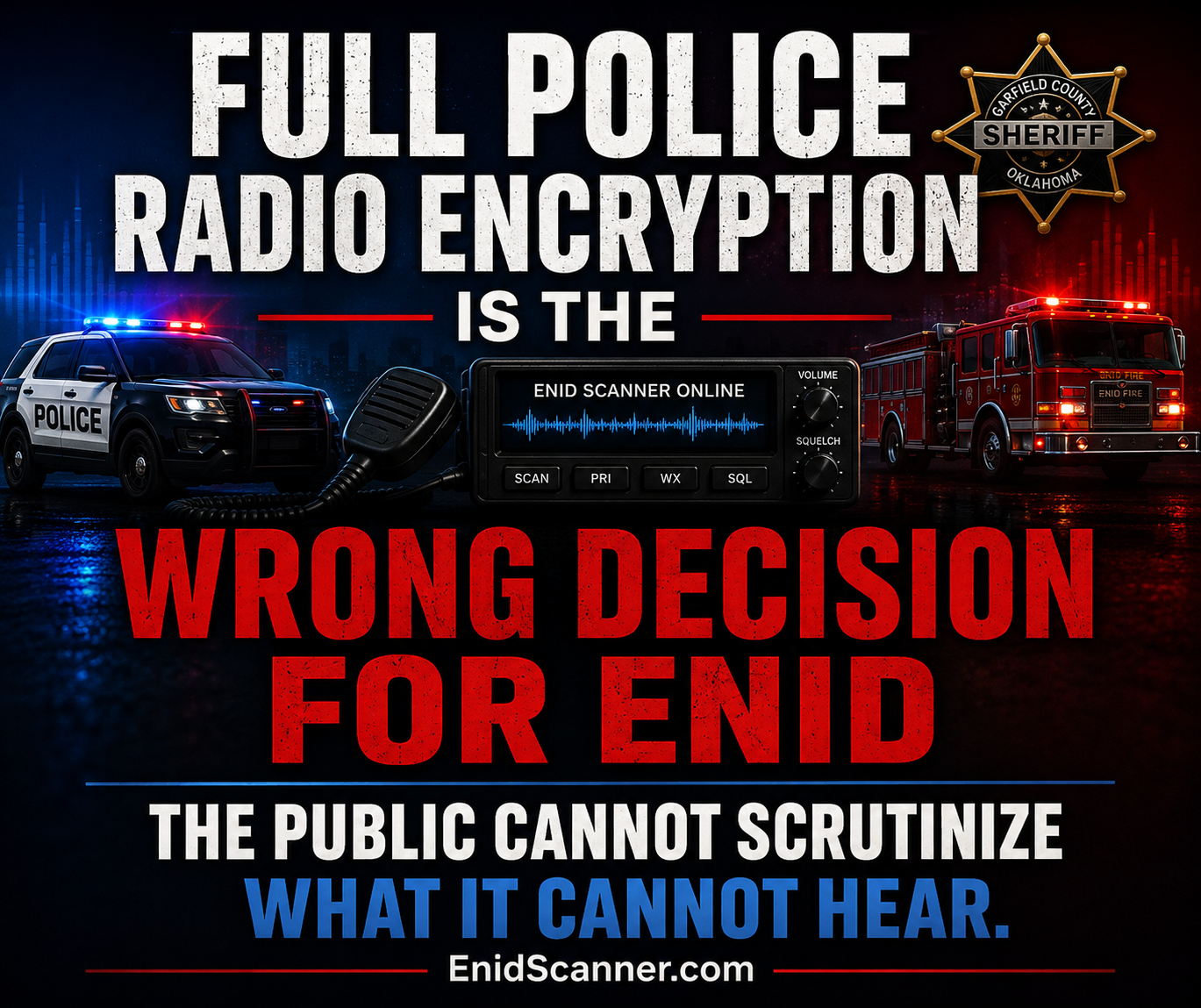
Enid Police has announced plans to fully encrypt its radio communications, permanently removing Enid Police radio traffic from public access.
I support the Enid Police Department and the officers who serve this community. I do not support this decision.
Before nearly two decades of public access is permanently removed, residents deserve evidence, answers and an opportunity to be heard.
Full Police Radio Encryption Is the Wrong Decision for Enid
Public Statement from EnidScanner.com
I have always supported the Enid Police Department and the difficult work its officers perform for this community. I remain a supporter of the men and women who serve Enid.
But supporting an organization does not require silence when it makes a deeply misguided decision.
I strongly oppose the department’s plan to fully encrypt its radio communications. It baffles me that the department would choose the most restrictive possible response without first proving that its concerns were caused by public scanner access or seriously considering what the public would lose.
This decision is unnecessarily extreme, poorly justified and, frankly, absurd.
The announcement reads less like a documented risk assessment and more like someone in a tie needed a project, gathered a handful of frightening possibilities and chose the broadest restriction available.
For nearly two decades, I have operated EnidScanner.com as a hobby and a free public service. Enid police and fire audio was publicly available online by at least June 2007. I have continued investing my own time, money, equipment and effort into keeping that service available. I make no money from providing it.[2]
Full encryption would not merely inconvenience scanner hobbyists. It would destroy the core service I have spent nearly 20 years providing to Enid.
Full Encryption Does Exactly What the Department Denies
The department states:
“This decision was not made to hide anything from the public.”[1]
Let us stop playing word games.
Encryption is specifically designed to make communications unintelligible to anyone who does not possess the encryption key.
Whatever motive the department claims, if every police radio transmission is encrypted, every police radio transmission is being hidden from the public.
The honest statement would be:
“We have decided the public should no longer be allowed to hear Enid Police radio communications.”
I am not arguing that Enid Police is forbidden from encrypting its system. I am arguing that having the authority to do something does not automatically make it necessary, intelligent, proportionate or good public policy.
Once everything is encrypted, residents must depend entirely upon information selected, reviewed, summarized and released by the same department whose actions they may want to examine.
The department will control:
- What information is released
- When it is released
- Which details are included
- How each incident is characterized
That is not transparency.
The public cannot scrutinize what it cannot hear.
Police reports, body-camera footage and media releases may eventually become available, but only after the department has reviewed and framed the information. Live radio provides something fundamentally different: an independent, contemporaneous window into events as they develop.
A Smarter Alternative Already Exists
My position is straightforward.
Encrypt communications involving:
- Tactical operations and exact officer positions
- Active investigations and undercover activity
- Criminal-history and personally identifying information
- Medical, victim and juvenile information
- Any transmission creating a specific and legitimate safety risk
Keep routine dispatch and community-wide emergency communications publicly accessible.
Sensitive information belongs on secure tactical channels. That is a targeted response to a targeted concern.
Hiding every routine dispatch transmission around the clock is not.
The AI Claim Is Speculation Presented as Fact
The department says applications can use artificial intelligence to transcribe radio traffic and “sometimes” create unnecessary panic.[1]
What application?
What Enid incident?
What inaccurate information?
What documented panic or harm resulted?
None of that information was provided.
AI can transcribe audio. That is a technical fact.
What has not been established is that AI-generated scanner information created a public-safety crisis in Enid, injured anyone, compromised an operation or caused enough measurable harm to justify removing access from every resident.
A technical possibility is not a documented incident.
A hypothetical is not evidence.
The words “can” and “sometimes” are doing nearly all the work in the department’s statement.
This reads like a knee-jerk, feel-good response to a modern technology buzzword. It creates the appearance that officials have solved a new technological problem without proving that the problem occurred here or that full encryption would solve it.
AI can generate a false emergency post without hearing one second of scanner audio. Social-media rumors will continue after encryption.
Removing direct access to official communications may make misinformation harder to challenge because residents will lose a source carrying official updates and corrections as responders determine what is actually happening.
False Shooting Reports Were Not Caused by Scanner Audio
The department cites false reports of shooting events called in by someone experiencing a mental-health crisis.[1]
By the department’s own description, the false information originated with the caller.
A scanner did not make the call, invent the shooting, cause the caller’s crisis or place false information into the emergency system.
Encryption cannot prevent someone from making another false emergency call.
Encryption would hide the response to the false report. It would not prevent the false report.
Connecting a frightening false-shooting call to scanner access without establishing a causal relationship is fear-based rhetoric.
It sounds alarming in a media release, but it is not evidence that public radio access caused the incident or made it worse.
If scanner access played a role, the department should explain exactly how.
Otherwise, the example has nothing to do with the policy being justified.
Social Media Will Exist With or Without Scanner Audio
The department also states that officers’ real-time locations were posted to social media during an active-shooter event.[1]
Publishing precise tactical positions during an active attack can create a legitimate safety concern. That supports protecting tactical communications.
It does not justify hiding every routine transmission.
Smartphones, Facebook Live, doorbell cameras, security cameras, witnesses and news coverage will continue to exist after encryption. People standing near an incident can see and livestream police vehicles, roadblocks, staging areas and visible officer movements.
By the department’s logic, preventing the possible disclosure of visible officer locations would also require banning cellphone recording, Facebook Live and live news coverage whenever police respond to a public incident.
That would be absurd. A blanket attempt to prohibit people from recording police performing public duties would also collide with First Amendment protections recognized by the Tenth Circuit, whose decisions apply in Oklahoma.[6]
We address actual misuse. We do not eliminate every lawful and beneficial use because misuse is possible.
Full encryption will not end public observation. It will eliminate one of the few sources carrying direct official communications, including updates and corrections that can help residents distinguish developing facts from social-media rumors.
Tactical positions belong on tactical channels.
Hiding every routine dispatch transmission around the clock is not a rational substitute.
Real-Time Information Can Protect the Public
The department describes rapidly spreading information only as a threat.
During tornadoes, major fires, widespread power failures, hazardous-material incidents and other community emergencies, timely information can help residents avoid blocked roads, downed power lines, damaged neighborhoods, fire scenes, rescue operations and congested emergency routes.
On April 23, 2026, an EF4 tornado traveled through the Vance Air Force Base and Enid area. The National Weather Service documented a ten-mile path through Garfield County.[3]
That is precisely the type of emergency during which residents need every reliable source of developing local information available.
Scanner audio does not replace National Weather Service warnings, 911 or official safety instructions.
It provides an additional real-time window into the official emergency response.
Full encryption closes that window during the moments when it may matter most.
Show the Public the Evidence
The department concludes that publicly accessible radio communications create “far too much harm than good.”[1]
That is not a statistic or documented finding.
It is an opinion presented as though the balance has already been measured.
No study was cited. No incident count was released. No cost-benefit analysis was provided. No documented pattern of scanner-related injuries or failed operations was presented. The public benefits were not measured, and less-restrictive alternatives were not discussed.
Before moving forward, the department should publicly answer:
- How many verified incidents were directly caused by scanner monitoring?
- How many officers were injured because someone heard routine radio traffic?
- How many police operations were compromised or failed?
- What specific AI-transcription incident occurred in Enid?
- What measurable panic or harm did it cause?
- Did the cited social-media information originate from scanner traffic?
- Did a suspect see, use or benefit from that information?
- Why are secure tactical channels insufficient?
- Why was selective encryption rejected?
- What public-safety benefits of open communications were evaluated?
- What replacement transparency and emergency-information measures will be provided?
- What public review occurred before the broadest possible restriction was selected?
Public online access to Enid police and fire audio is documented as far back as June 2007.[2]
After nearly two decades, the public deserves more than hypotheticals, frightening anecdotes and an unsupported declaration that harm outweighs good.
Enid is also not confronting a problem that no other department has faced. As of July 18, 2026, Broadcastify listed multiple Chicago Police Department zone feeds as official feeds and online. An NYPD Citywide feed also remained publicly available online.[4][5]
Chicago and New York are vastly larger and more operationally complex than Enid. Their continued public availability demonstrates that complete public exclusion is not the only possible policy.
The department declares that the harm outweighs the good without showing the public either side of the scale.
What Can Be Measured as FACT Is the Result
Full encryption will mean:
- Less transparency
- Less independent public information
- Less real-time awareness during emergencies
- Greater dependence on government-selected accounts
- Fewer tools for separating developing facts from social-media rumors
- The destruction of a free community service operating since at least 2007
Those are not hypothetical consequences.
They are the direct and predictable results of completely shutting the public out.
Enid Deserves Better
I support the Enid Police Department.
I support the officers who serve this community.
I do not support this decision.
Supporting the police does not mean residents must quietly accept every policy announced by police leadership. Respect does not require blind agreement, especially when a decision affects public transparency, emergency awareness and a community service that has existed for nearly two decades.
Full encryption is not a minor technical change hidden somewhere inside police operations.
It is a decision to remove every Enid Police radio transmission from public access.
It affects residents.
It affects journalists.
It affects public accountability.
It affects the flow of information during disasters.
It affects EnidScanner.com and the service I have personally spent nearly 20 years building and maintaining without charging the public.
A decision carrying those consequences should not be announced through a one-page media release filled with unsupported claims and then implemented as though the public has no legitimate interest in the outcome.
Chief Bryan Skaggs, if routine public radio access has injured officers, compromised operations or caused documented panic in Enid, release the evidence.
Show us the incidents.
Show us the analysis.
Explain exactly why tactical channels and selective encryption are not enough.
City Manager Jerald Gilbert, this is larger than an internal radio setting. The City Manager is responsible for overseeing City operations and advising the City Council. A decision that permanently reduces public access deserves your scrutiny, not automatic approval.[8]
Mayor David Mason and Commissioners Cheryl Patterson, Derwin Norwood, Frank Baker, Whitney Roberts, Rob Stallings and Courtney Dennis, you represent the residents who are about to lose that access. The City publicly describes itself as committed to open and accessible government.[7][9]
Ask the questions the department’s media release did not answer.
Demand the evidence.
Ask why selective encryption was rejected.
Ask what this change will cost.
Ask precisely which channels will be affected.
Ask whether Enid Fire, Animal Welfare, Parking Enforcement or other services will also disappear from public access.
Ask what system will replace the real-time public information being removed.
Most importantly, give residents an opportunity to speak before this decision becomes permanent.
I am not asking the City to choose my hobby over officer safety.
I am asking the City to reject the false choice that it must encrypt everything or protect nothing.
Protect tactical operations.
Protect exact officer positions.
Protect victims, juveniles, medical information, personal data and active investigations.
But do not use those legitimate concerns as justification for hiding every routine dispatch transmission from every resident, journalist and responsible listener.
This decision should be paused immediately.
The evidence supporting it should be released.
Selective encryption should be publicly evaluated.
The issue should be discussed before the Enid City Commission, and residents should be given a meaningful opportunity to comment before public access is permanently removed.
Enid deserves better than a permanent transparency decision supported by hypotheticals, alarming anecdotes and conclusions for which no data has been shown.
The public cannot scrutinize what it cannot hear.
Jeff – EnidScanner.com
Take Action
Residents who oppose full encryption should contact the officials responsible for City policy and police administration.
Suggested subject:
Pause Full Enid Police Encryption and Hold a Public Discussion
Suggested message:
I am asking the City of Enid to pause full encryption of Enid Police radio communications.
Before public access is permanently removed, the Police Department should release the evidence supporting this decision, explain why selective encryption was rejected and allow meaningful public discussion before the Mayor and City Commission.
Please protect tactical operations, exact officer positions, investigations and genuinely private information while preserving routine dispatch and community-wide emergency communications.
Please place this issue on a public City Commission agenda before full encryption is implemented.
Copy-and-Paste Email Recipients
bskaggs@enid.org;
citymanager@enid.org;
dmason@enid.org;
ward1@enid.org;
ward2@enid.org;
ward3@enid.org;
ward4@enid.org;
ward5@enid.org;
ward6@enid.org;
crains@enid.org
Contact Information
ward3@enid.org
Residents may also request the records supporting this decision through the City’s official open-records process.[10]
References
[1] Enid Police Department.
“Radio Communications to be Encrypted.” Media release provided with this statement.
[2] RadioReference Forums.
“81 new feed links added to my site and other updates.” Published June 1, 2007. The listing includes “OKLAHOMA – Enid Police, Fire, Ham.”
https://forums.radioreference.com/threads/81-new-feed-links-added-to-my-site-and-other-updates.71573/
[3] National Weather Service, Norman, Oklahoma.
“2026 Oklahoma Tornadoes” and “The Severe Weather and Tornado Outbreak of April 23, 2026.” The NWS documents an EF4 tornado traveling ten miles from southwest of Vance Air Force Base to east-southeast of Enid.
https://www.weather.gov/oun/tornadodata-ok-2026
https://www.weather.gov/oun/events-20260423
[4] Broadcastify.
Chicago Police Department Zone 08 and Chicago Police Department Zone 03. Both were identified as official feeds and online when verified July 18, 2026.
https://www.broadcastify.com/listen/feed/37361
https://www.broadcastify.com/listen/feed/37356
[5] Broadcastify.
“NYPD Citywide 4.” Listed online when verified July 18, 2026.
https://www.broadcastify.com/listen/feed/40187
[6] United States Court of Appeals for the Tenth Circuit.
Irizarry v. Yehia, 38 F.4th 1282 (10th Cir. 2022). The court recognized First Amendment protection for filming police performing public duties.
https://www.ca10.uscourts.gov/sites/ca10/files/opinions/010110708555.pdf
[7] City of Enid.
“City Council.” Current mayor, commissioners, official email addresses and telephone numbers.
https://www.enid.org/Government/City-Council
[8] City of Enid.
“City Management” and City Manager staff directory. Identifies Jerald Gilbert as current city manager and describes the city manager’s operational and advisory responsibilities.
https://www.enid.org/Government/City-Management
https://www.enid.org/I-Want-To/Contact/Contact-the-City/Staff-Directory/City-Manager
[9] City of Enid.
“Office of the Mayor.” Identifies Mayor David Mason and states that the City is committed to open and accessible government.
https://www.enid.org/Government/Office-of-the-Mayor
[10] City of Enid.
“Request Open Record.” Official City and Police Department open-records contacts and request forms.
https://www.enid.org/I-Want-To/Request-a-an/Request-Open-Record